11 · Dispatches
Fans, mood and the ground
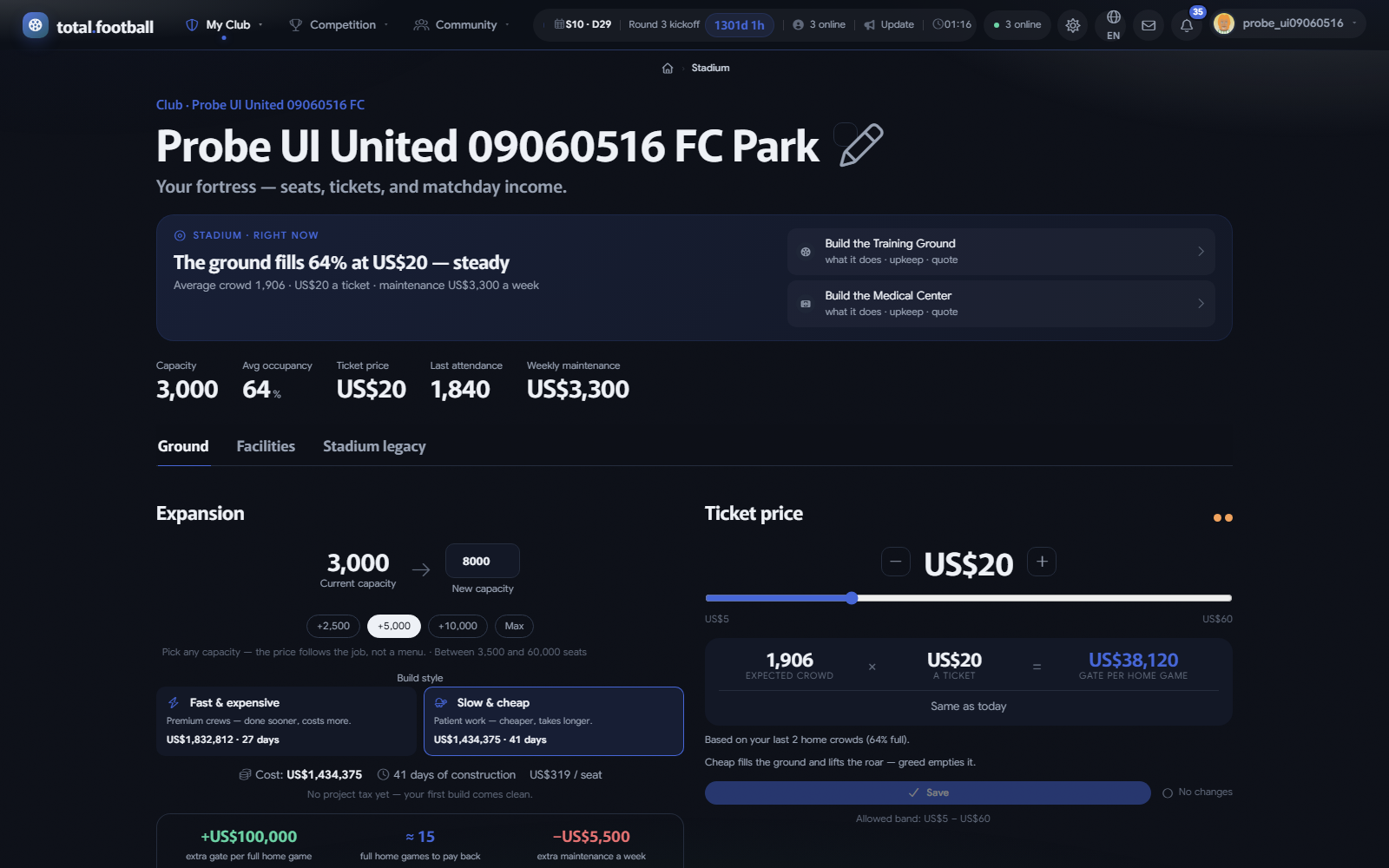
The fans are not a number that goes up when you win. They are a mood, 0 to 100, recomputed after every match and every day — and the mood moves the gate, the sponsors, the press and the dressing room. Here is what moves it, and what the ground has to do with it.
What moves the mood.
| Driver | How it works |
|---|---|
| The last five results | Weighted 50 / 25 / 13 / 8 / 4, newest first — and each is read against the one before it: a win after a loss is a comeback, a loss after a win stings, a losing streak compounds hardest. |
| Where you are vs where they expect you | Your reputation rank in the league sets the expectation; the table sets the verdict, from −35 to +45, and it weighs more as the season goes on. |
| Events | A new-season honeymoon (25 days), the last match for four days, a cup run while you are alive (the deeper, the prouder), a cup exit for ten days, leading the league, a homegrown player in the eleven, too many foreigners, construction at the ground, a sponsor's glow — and a neglected academy. |
| Your spokesperson | A staff role: five percent of the bad feeling recovered per star. |
The mood speaks in the fans' voice on your club page — ten steps from “we're gonna burn this club…” to “wow, our team plays just great” — and everyone can read it.
What the mood touches. Attendance (a few percent either way), the press (angry fans bring more ambushes), the crowd's reaction to a substitution, and which sponsors will sit at your table — some brands do not sign angry clubs.
The gate. Base fill runs from 35% for a club nobody knows to 95% for one everybody does. Form swings it ±15%; a big opponent adds up to 12%; a famous name in your eleven sells a few more; a ground with history pulls people on its own. And the ticket: $5 to $60, $20 is fair. Halve the fair price and you fill 18% more; double it and you empty 35%. Fans forgive cheap and punish greed. The away end pays a premium and travels on its club's pull.
Building. Any number of seats, 500 at a time, up to 60,000. The price per seat starts at $250 and rises as the ground grows; a builder lays 150 seats a day (7 to 120 days). Pick a style: fast (×1.15 cost, ×0.8 time) or cheap (×0.9 cost, ×1.2 time). Every finished project makes the next one 10% dearer, up to double — the town's contractors know a spender. For the ladder-minded: 3,000 → 5,000 is about $400k and two weeks; 30,000 is a $6.5M, eight-week job.
When to build. When you are selling out at a fair price, and not before: every 1,000 seats cost $1,100 a week whether anyone sits in them. Naming the ground pays (the naming sponsor slot) and grumbles (the fans notice). Renaming it yourself costs $250k — identity is expensive.
Tomorrow: the miracle law — the one rule every system in this game was written under.