9 · Dispatches
Four ways to sign a player
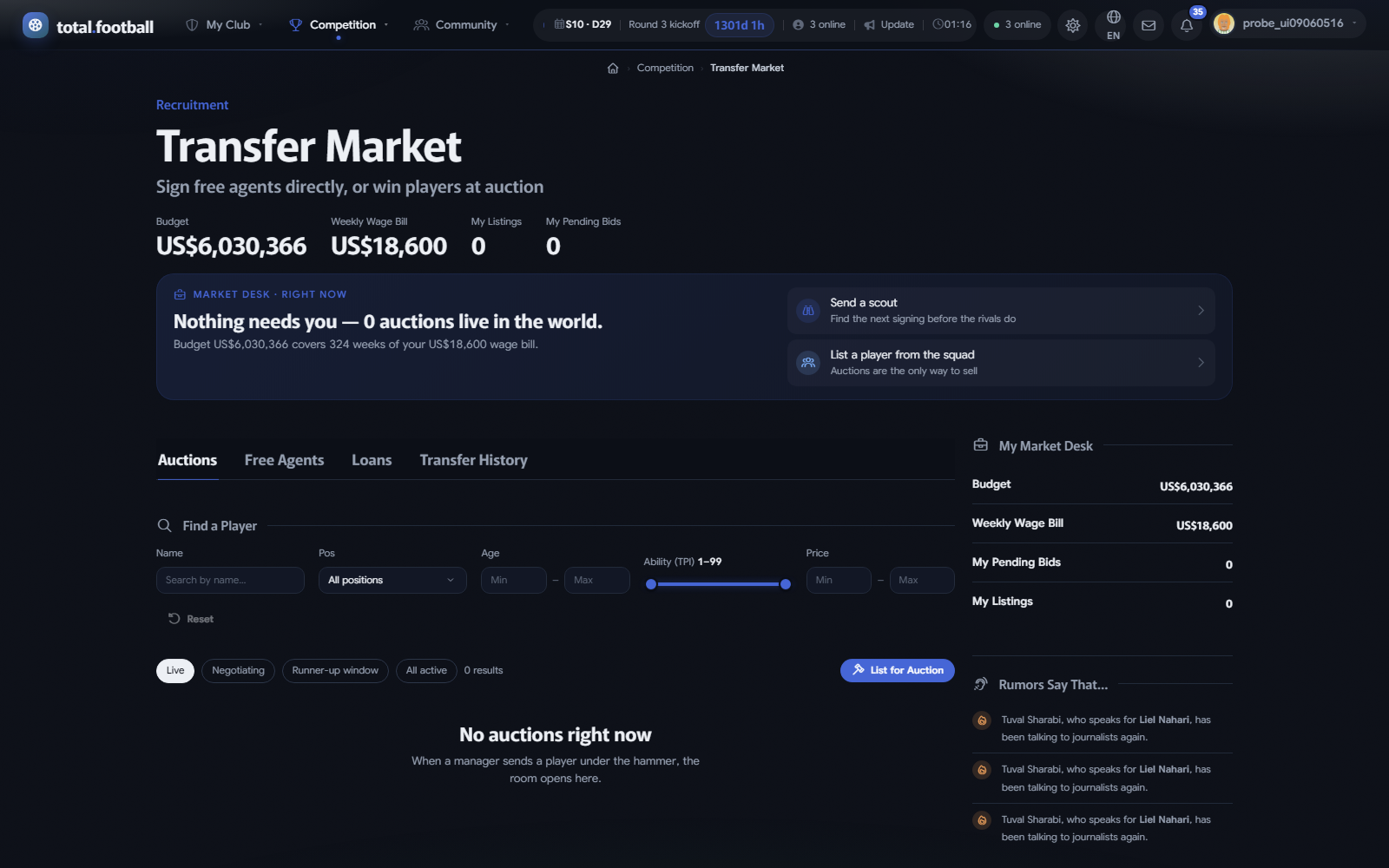
The market is open all season. Four doors into it — and each one has its own price, its own clock and its own risk.
| Auction | Free-agent talks | Loan | Release clause | |
|---|---|---|---|---|
| Who | Another manager's player | A player without a club | Another manager's player, for a while | Any player with a clause |
| Clock | 24–48 hours, open ladder | 24 hours from the first offer | A proposal, 7 days to answer | Instant |
| Price | The hammer, inside ±60% of fair value | No fee — wage, years, bonuses | Fee up to 15% of value + a wage split | The clause, exactly |
| Who decides | The bidders, then the agent | The agent, in secret | Both clubs and the player | Nobody can refuse — except the agent on the wage |
Auctions. Only managers list, only their own players, for 24, 36 or 48 hours. The ladder is public: every bid, every club. Each bid is at least 2% (and $1,000) over the last; a bid in the final five minutes adds five more. The league keeps prices honest — a listing or a bid more than 60% off the player's fair value is never ratified, and a deal that lands far from it goes to the jury. The hammer buys the right to talk: six hours with the agent, a wage offer (his current wage plus 10% by default — improve it if you must), a three-year contract, no clauses. If the agent says no, the second bidder gets twelve hours. Money moves one to one, seller to buyer, no tax.
Free-agent talks. Your offer opens a 24-hour window. Rivals may join; you see how many and the agent's mood, never their numbers, and nobody can lower or withdraw. You set the weekly wage, one to five seasons, and what you like of the five clauses: signing bonus (paid once, up to 26 weeks of wage), loyalty bonus, minutes step-ups, a jersey royalty, a release clause. At the deadline the agent weighs the packages — money, years, your division and reputation, how deep you already are in his position, how you two get on — against the player himself: his traits, his age, his mood, how long he has been waiting. A package well above his floor is very hard to refuse. No fee.
Loans. Manager to manager. Full season, first half (to week 11) or second half; three out and three in at most; a fee up to 15% of his value; the wage split as you agree (half and half by default, 20–80 either way); a recall clause if you want him back after four weeks, with a week's notice. The borrower's yes is not enough — the player must want to go, and a benched player wants it more. There is no option to buy; if you love him, wait for the auction.
Release clauses. Written at signing or renewal, at least half his fair value. Any manager can pay it — you cannot refuse — and the buyer still has to satisfy the agent on the wage. Write one high and it is a shield; write one low and it is an invitation.
Two more things. There is no hard squad cap: the dressing room simply sours from 26 players up (a spokesperson on the staff buys you a body per star). And renewals open 28 days before a contract ends — he asks his market rate; clauses can talk him down to 75% of it.
My rule of thumb for Season 1: sign free agents first (they are the players the dissolved clubs left behind), auction when you must, loan the young for minutes.
Tomorrow: growth, potential and the academy — how a point is earned, the aging DNA, and the school you fund or neglect.