8 · Dispatches
Money
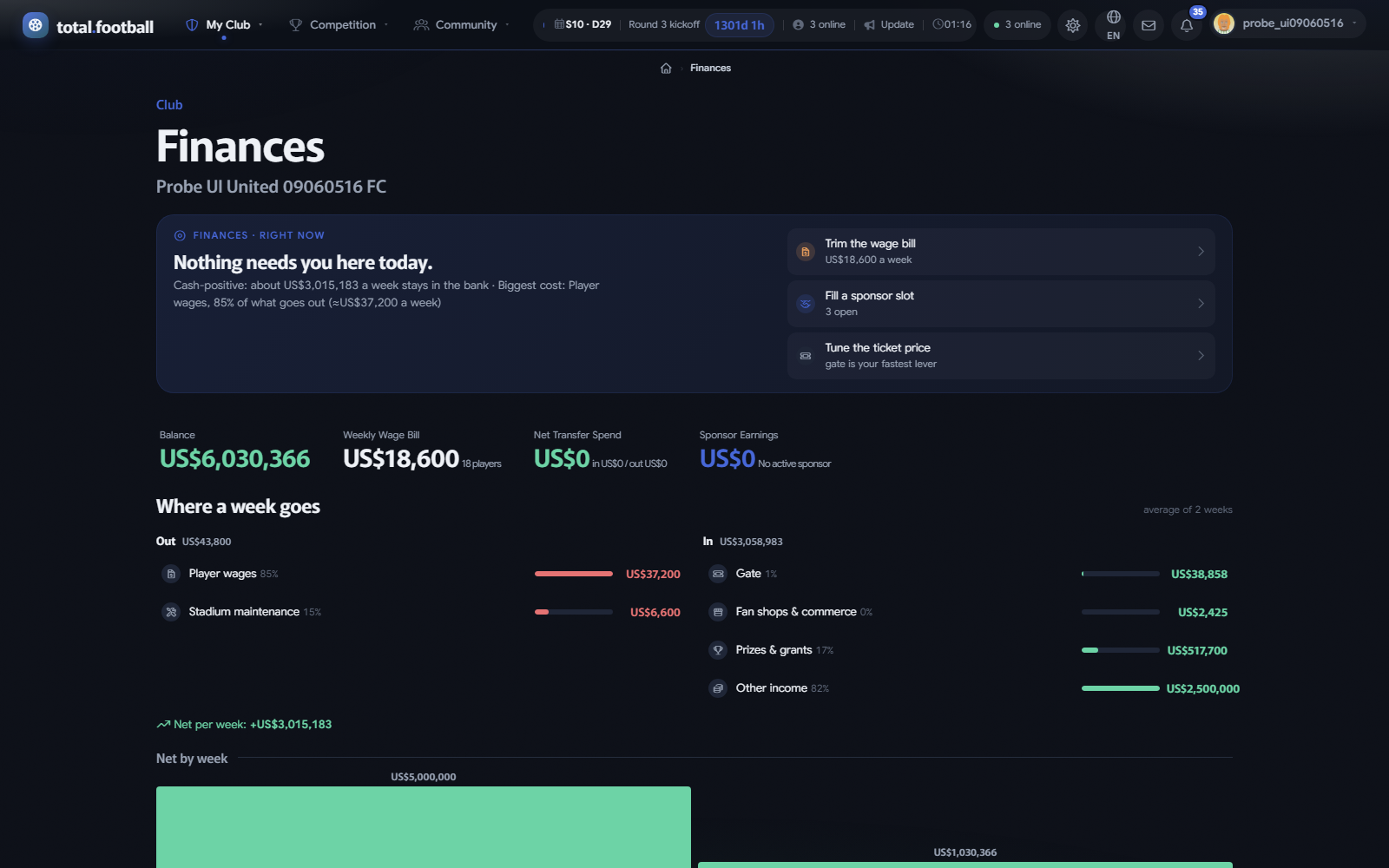
One currency, dollars, the same for every country — so managers can talk numbers to each other. Here is where the money comes from, where it goes, and the one rule that keeps a club alive.
Day one. $1.5M in the bank, a 3,000-seat ground, no staff. The board adds $3.5M more — not as a lump, as grants for doing the first things right:
| Do this | The board pays |
|---|---|
| Set a lineup · set training · hire a coach · hire a physio · order a scout report | $300k each |
| Shortlist three players | $250k |
| Play your first match · win your first point | $500k each |
| All of the above | $750k |
Every Sunday the week turns. Out: player wages, staff wages, ground upkeep ($1,100 a week per 1,000 seats — $3,300 for the starting ground), whatever you put into the academy. In: the federation grant — $5,100 a week in the top division, $4,700 in the second, $3,000 in the third.
Match days pay the gate. Attendance times the ticket price: $5 to $60, and $20 is what the crowd calls fair — go above it and fewer come; the away end pays a premium; a friendly brings a third of a normal gate. Fans buy shirts and merchandise all season, sized by how many follow your players.
Sponsors are the other engine. Three slots — shirt, secondary, naming — and every deal carries two to four clauses that pay when things happen: a match played, a win, a goal, a clean sheet, a full house, a derby, a cup run. A signing bonus up front (six weeks of the base), an end bonus if the deal ends well, a cash advance if you need it (repaid at 35% a week from the streams). An empty pair of slots pays your one sponsor a 25% exclusivity premium. A betting sponsor pays well and closes the door to family brands — a trade, not a trick. Offers arrive by themselves; a good spokesperson on your staff makes them better.
Cups and transfers. The cup final's pool grows with the hosting bids clubs make for it. Selling a player at auction is the fastest money in the game — and the slowest to replace.
The rule. Keep wages — players and staff together — under about 85% of what comes in. That is the band the whole world is tuned to: a mid-table club spends 70–85% of its income on wages and upkeep and lives on the rest. One bad season hurts. Two force a sale. Bankruptcy is possible, and always self-inflicted.
The slow, sure investment. Seats. Every 1,000 you add cost upkeep forever and pay every home match forever. Build when the ground is full, not before.
Tomorrow: four ways to sign a player — auction, free-agent talks, loan, clauses — and which one to use when.